Sunday, October 28, 2012

Civil Disobedience or Obedience?

We always have to ask ourselves whether government is effective or not, and what we can do to change it. Even though a basic government upholds the law, establishes safety, and creates educational opportunities, we should still be well-informed citizens and actively participate in the decision making processes, seeking change as opposed to mindlessly following unreasonable rules. Yet, while a destructive government ought to be reformed, it is still better than no government and absolute anarchy. 

Henry David Thoreau, out of a fit of anger, tells us all that we should have no government at all, that the current government is corrupt and we are all mindless powder-monkeys. Is his statement valid just because he was jailed on the grounds of not paying poll taxes for six years? As a transcendentalist, he states in Civil Disobedience that he would like everyone to stand up against government. I have no problem with that part; as long as the reason for civil disobedience is well grounded and peaceful, it is excellent to participate in policy-making. However, his statement that the whole government ought to be done away with is going a little too far. Man has not advanced to the point where he can live in peace with his fellow citizens, so sooner or later, someone will undermine the whole utopia and take over control. Instead of waiting for that moment, it is better to maintain a government system that serves its people.    

The political treatise written by Niccolò Machiavelli questions Thoreau's statement that we should not have government at all, and that we ought to govern ourselves. According to The Prince, there must be an effective leader at the head of his peoples in order to rule fairly. Although politics are amoral, it is up to the prince to make good decisions and do whatever is necessary to maintain power, even if it means being a feared leader than a beloved one. How does this connect to Thoreau though? After all, Machiavelli did come several centuries before Thoreau did. In essence, it is crucial to have a government of some sort. If there is no effectively ruling government (or there is and it is floundering) a dictator or higher power will rise up to the helm. It would be in the best interests of America to keep a Democracy instead of turning to Anarchy or Communism (which is still not necessarily equal). 

Sunday, October 21, 2012

You can run, but you can't escape from Appeals.

Appeals are incredibly persuasive, and almost no one can resist it's allure. Whether it's to make you buy merchandise, choose a side, or change your mind, appeals work without fail in tugging at your heartstrings. While some people shun it as being deceiving, I disagree because it essentially adds flavor to any argument and is not so much deceiving as incredibly exaggerated. All in all, it's a very effective mode of persuasion.

The Crisis by Thomas Paine is an excellent example of writing loaded with various logical, emotional and ethical appeals. Every time I read "These are the times that try men's souls" I can almost envision freezing, hungry men that are huddled around a campfire reading this pamphlet. With the continued praise of their hardiness in such poor times, I picture them as glowing with pride, and then rage at the "summer soldier and the sunshine patriot" who are too scared. Paine uses logic to tell the soldiers that while the battles may be lost, they will certainly win the war. He goes on to appeal to ethics and emotions by picturing the British as a cruel, heartless people, and the patriots as courageous and bringers of liberty. By the end, I should think that the soldiers are screaming and cheering, ready to take on the British. While The Crisis was effective propaganda, I'm sure that some of the facts were twisted around, and that the British had a similar pamphlet with completely different arguments.

I think all of us are incredibly impulsive creatures. Almost every week my family goes through the dilemma of impulse shopping; my dad has a predilection for sweets, my sister likes accessories, and my brother is obsessed with technology. I too am a hypocrite, for while I preach against the evils of impulsive buying and excessive spending, I still succumb and end up buying things that are too cute not to be bought. On another note, we as humans do lots of television watching; sometimes, the media can be a little biased, and the commercials and news segments might try and influence us by bringing out starving children, skewed statistics, or other heartbreaking news. Earlier, while I was on the edge of considering whether or not to donate to the Kony 2012 rage, I did a little research past the sob story and realized that a small percent actually went to the children, so I opted for UNICEF instead. Even thought some of the ads and appeals we see may be trying to get at a real point, I think it is best if we all try and take on a more critical mindset and weed out fact from flowery language. It doesn't hurt to have an appeal control us once in a while, but we shouldn't completely rely on these appeals and advertisements for a straightforward truth.


Sunday, October 14, 2012

Just Say No!

Saying no to social norms is extraordinarily difficult, especially if people expect a certain behavior from you. In hindsight, we may look upon a situation as incredibly silly and obvious, perhaps even getting overconfident as to declare that you would never be a passive player. “If I were in that situation, I would…” we may say, but in reality it is a lot easier said than done. What does it take for us to step out of our bounds and actually go against something?


In the case of Kitty Genovese, over 38 people witnessed her slaying, yet no one bothered to offer deliverance by reporting the crime or getting involved. These people were not bad; they were decent citizens much like you and me. Later, they felt overwhelmed with guilt, much like Reverend Hale from The Crucible, for not helping out or even reporting the situation. To an extent, even Judge Hathorne and Danforth realized that their proceedings were ignoble, yet they went on with the show. From all of the good people in Salem, only a few decided to call out the Church and denounce the “witchcraft”. It must be understood that the mob mentality controls the lives of these people, and once caught in the tide, shifting to the other side is difficult. 

I witnessed a case of bad fellowship myself, and unfortunately, was one of the passive spectators. During summer, I visited the Upper Peninsula. I was walking up a hot hilly dune that led down a bluff to the water. As I took pictures, I noticed a boy next to me lying in the sand, unresponsive and breathing shallowly. At first, I wanted to bend over and shake him to check if he was okay, but I thought that with the over fifty people present, it would be best not to interfere. No one else really cared, so maybe he was just resting. So, instead of doing what I thought was right, I walked on. Later, when I walked back, there was a large group of people surrounding him and giving him water. He was carried out on a stretcher for heat exhaustion. I felt glad that someone cared, but miserable about being so passive. I also realized how hard it is to step out of the crowd and actually do something, because of our unconscious fear of being wrong or placing our own lives in jeopardy. It certainly takes the strong-willed to be good Samaritans.
                                                                                                                                      

Sunday, October 7, 2012

Hysteria and Vengeance = Bad Romance

Hysteria drives people out of their minds and causes fear in the general population, usually incensed by poor economic growth and bitterness. Vengeance drives us to seek revenge served cold, bringing up ancient grudges and inflicting pain upon others in satisfaction. When coupled together, they make a powerfully dangerous mine capable of destroying the order of society. 


In Arthur Miller’s The Crucible, Abigail is bent on killing Mr. John Proctor’s wife and marrying him. She is made a demagogue, the leader of her merry band of witch-crafting girls, and they accuse anyone who has spited them in the past. They tell apocryphal stories to the point where they cannot discern between what is truth or not. From only a few people accused of being a witch, the situation explodes to the point that bitter people attack neighbors for having some fault at all. Revenge is seen in the form of the capture of Mr. Giles' wife and Elizabeth Proctor. The flames cannot be extinguished, and the fire is spread by the relentless wind that attacks their town. Innocent people confess to witchcraft and then turn on others, attempting to save their own skin before others, which only makes the situation worse. Hopefully, someone will attack the root of the hydra, Abigail Williams, and end the madness!
 
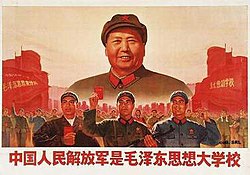
Hysteria and revenge connects to almost every tragedy in history. The Cultural Revolution in China is in my opinion, one of the most devastating events to have occurred, where hundreds of years of history were shattered. Roused by Chairman Mao Zedong, hundreds of people disillusioned with the battering and economical state of China were incited to attack the bourgeois and destroy any relics, bringing their country into the new world. When faced with a hero to lead them to safety and victory, the people followed and began attacking each other. Vengeance set in; due to the fact that only a witness was needed to charge them. Jealous neighbors would report “unfaithful” neighbors and then destroy their homes. Thousands of people led fearful existences—especially landlords—or were thrown into jail as family members turned on each other. Those who did report others were extolled as heroes of the revolution, so it only encouraged this fanaticism. It was not until much later that people began to reflect on this dark chapter and realize the horrors of their actions, caused by a mixture of disenchantment of society and the poor economic state. This event is surely a travesty, but it is not the only one in history. 

Sunday, September 30, 2012

Everyone loves the Puritans!~


The puritan legacy is seen all throughout literature in different forms, clinging fast to diverse areas such as prose and poetry. In a way, it censors the expression of human thought, yet still delineates the values of morals and human nature. Puritan ideals and even writings have left a large imprint upon history that have yet to be effaced.

Puritan legacy can be seen even after the era passed. Nathaniel Hawthorne’s The Scarlett Letter is a key example, though the language is slightly more romantic (emotional) than puritan language. Hawthorne is able to explore the darker side of human nature through Hester Prynne and Arthur Dimmesdale’s adulterous affair (and young Pearl, the result of it) in a puritan society. Old Roger Chillingsworth falls from grace with the horrific realization of his wife’s infidelity and becomes wicked, tormenting the two. Hawthorne believed that some sins ought not to be punished so severely, gently ridiculing the close-mindedness of the era. From his work, lessons are to be learned, that adultery should not be played with, and that it is also senseless to punish sins harshly because no one is pure. However, Hawthorne seems to agree with Puritan work ethics, and shows Hester Prynne as a hardworking individual who has been chastised for her sins.

Sometimes, after turning to puritan works, I often wonder why few people follow puritan ideals today. Although puritans were rather obstinate in their religion, their standards of hard work, education, and modesty are honorable and should be emulated. Their stubborn refusal to die out during the harsh seasons in an unfamiliar area resulted in a legacy that somewhat morphed into the American Dream. Their strong attitude against suggestive material is a far cry from the shocking things that we see and hear today. Even though puritans may have held a close-minded attitude towards other religions, their morals can still be admired.

Saturday, September 22, 2012

Caveat Emptor! Minus the buyer.


To digress from the subject, I just want to clarify that my blog title does not refer to the pop song “Call Me Maybe”, but rather the first line of Moby Dick, “Call me Ishmael”.

What is marginalization? It’s when people are treated like outcasts and relegated to the darkest depths of society. Most often, it has to do with one culture or race believing themselves superior to another. Different heritages, I think, should be celebrated, not just tolerated. They are my raison d’être! Our backgrounds make us unique, but sadly, it is also what creates those stereotypes where we’re aggregated with others and then judged.

Sherman Alexie does a fine job of expressing the hurt and pain from being marginalized so often. He is able to address those “Indian” stereotypes in such a way that you sympathize with him and realized that everyone is human. Through his fictional characters, he states that others perceive him as being the apotheosis of Native Americans: stoic, long flowing black hair, brown skin, drunk, poor. While some parts may be sadly true, he doesn’t enjoy the fact that people tend to group him in with all of the others, such as where the 7/11 worker in “The Lone Ranger and Tonto Fistfight in Heaven” thinks he’s a robber because he looks menacing. In “Indian Schooling”, he even profoundly delves into the fact that “being brown doesn’t make you brothers”, that some of the worst struggles are within the culture itself. He hints that some cultures are being divided by certain expectations, and that they hold themselves back. Overall, he demonstrates the deeply seated friction between his culture and others.

Being an American Born Chinese (ABC), I can somewhat relate to Sherman Alexie and marginalization. Although it is not as prevalent as before, my antecedents must have suffered discrimination. But, I have faced the impatient person who believes that minorities are somehow ignorant, or cannot speak English. Several times I have heard others speaking to my parents with the loud, childish babble that is often cooed to pets, even though my Dad has a Ph.D and my Mom a Masters, and both speak English well enough to be understood. Even though the scenarios are extremes and have long since changed, the ringing disparaging words still make me feel persona non grata and somehow not part of American society, even though I celebrate Christmas, cheer for the American team, and go to an American school.

Going on a tangent, I find that it is crucial to keep traditions alive. I am American and want to assimilate further, yet I don’t want to cast off my native roots, which make me whole. It’s the reason why I still speak to my parents in Chinese in public and in private (even if my accent is ghastly), ask my parents to explain ancient proverbs (and use them in conversations), and eat Chinese food more often than not. So many American-Chinese have lost sight of their past; embracing another culture does not mean throwing another away!

What are really frustrating are the cold-blooded battles within; we’re all brothers and sisters, and should help each other, not marginalize each other and divide an already divided culture. Mainland vs. Taiwan. Really? We’re all people. Instead of strengthening stereotypes that only skew the perceptions of others—and don’t represent the whole population—emphasizing individuality is key. (Maybe it’s understanding that’s a problem. It was only last year when I asked a fellow student what “white people eat”, because I couldn’t understand why they seemed to eat cheese and pizza all the time.) But, no one wants to be seen as a nameless face in a mass of yellow, or white, or brown, or red. It is all in the delicate balance between cultures.

Sincerely yours,

Annie

Thursday, September 6, 2012

At long last!

Through many hours of laboring, I have finally succeeded at one of my endeavours.
Yahoo!